 blog
blog
Buy Sustainable Teak Garden Furniture: 2026 Guide
Table of Contents
- Why Sustainable Teak Beats Cheap Outdoor Furniture
- What Makes Teak Garden Furniture Truly Sustainable?
- FSC-Certified Teak Outdoor Furniture: What the Label Actually Means
- How to Maintain Teak Garden Furniture for Decades of Use
- The Real Cost of Sustainable Teak Over 10+ Years
- Designing Your Outdoor Space with Teak and Bamboo
- End-of-Life Disposal and Climate-Specific Care
- Frequently Asked Questions
Last Updated: September 30, 2026
Why Sustainable Teak Beats Cheap Outdoor Furniture
If you want to buy sustainable teak garden furniture that outlasts cheap alternatives, the difference shows after two summers in the sun. Cheap outdoor furniture, typically made from softwoods or low-grade timber, warps, splits, and greys unevenly within a few seasons. This guide from Zenteak explains why that gap exists, what "sustainable" means on a label, and how to choose pieces you'll still be using in a decade.
What Makes Teak Garden Furniture Truly Sustainable?
Sustainable teak is timber harvested from responsibly managed forests or plantations where new trees replace those cut, so supply continues without depleting natural forests, and harvesting respects local ecosystems and communities.
Three factors determine whether teak furniture earns that label:
- Source of the timber: Plantation-grown or reclaimed, never illegally logged old-growth forest
- Certification: Independent verification such as FSC certification, not just a marketing claim
- Manufacturing ethics: Fair labour practices and low-waste production methods
Plantation-Grown vs Reclaimed Teak: Which Is Greener?
Plantation-grown teak comes from managed forests cultivated for harvest; reclaimed teak is salvaged from old buildings, boats, or structures. Both beat unsustainably logged timber. Plantation teak offers consistency and predictable supply; reclaimed teak has a smaller immediate footprint, denser grain, and deeper colour from decades of ageing, though supply is limited and pieces vary more in size and finish.
FSC-Certified Teak Outdoor Furniture: What the Label Actually Means
FSC-certified teak outdoor furniture carries timber verified by the Forest Stewardship Council, which sets standards for responsible forest management. The label confirms the wood was harvested in a way that protects biodiversity, respects Indigenous and worker rights, and maintains the forest's long-term health.
| Certification | What It Verifies | Best For |
|---|---|---|
| FSC 100% | All timber from certified forests | Full traceability |
| FSC Mix | Mix of certified, recycled, and controlled wood | Common retail standard |
| FSC Recycled | All timber reclaimed or recycled | Reclaimed teak pieces |
| PEFC | Sustainable forest management (regional schemes) | European-sourced timber |
How to Maintain Teak Garden Furniture for Decades of Use
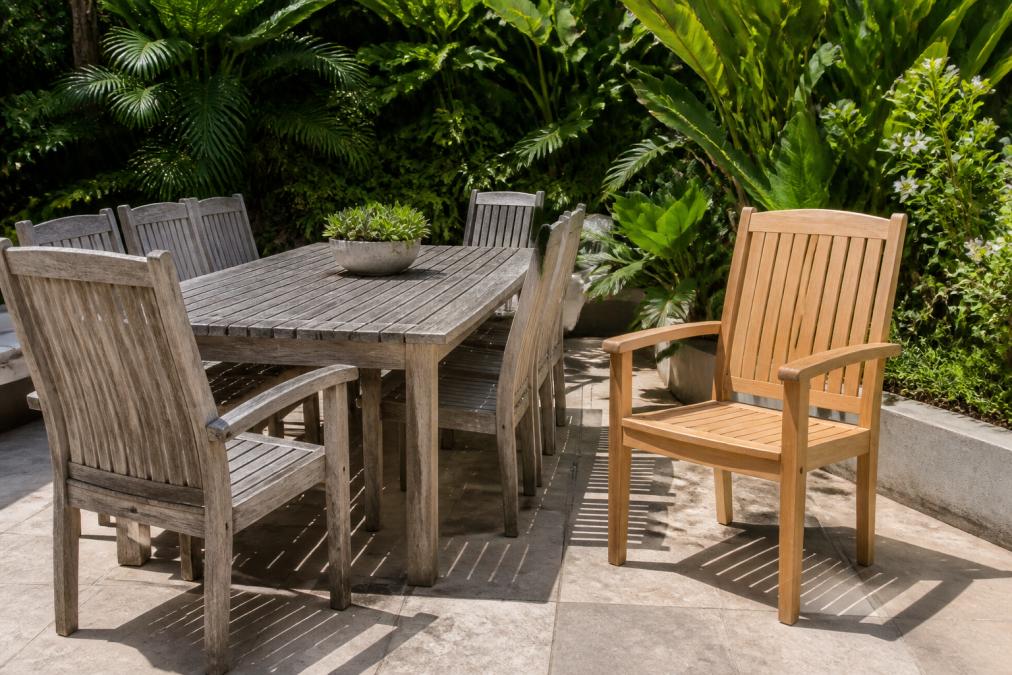
Learning how to maintain teak garden furniture is simpler than most people expect, though the schedule varies by climate. Left untreated, teak develops a silvery-grey patina as surface oils weather away, a look many prefer, while the timber underneath stays protected.
Climate-Specific Care: Humid Coastal vs Dry Inland
Teak's natural oils resist rot, but the surrounding air drives how fast the surface changes.
Humid and coastal conditions
- Patina develops faster because surface oils weather off more quickly in warm, moist air.
- Mould and mildew can colonise cushions, covers, and the underside of table tops where airflow is poor. Check monthly during the wet season.
- Salt spray dulls the grain. Rinse with fresh water and mild soap every few weeks near the coast.
- Metal fittings corrode faster. Inspect and tighten them each season, replacing any that show rust before it stains the timber.
- Let furniture dry fully after rain before covering it; trapped moisture is worse than leaving it exposed.
Dry and inland conditions
- Lower humidity means the timber loses surface moisture faster, so the grain can develop fine surface checks if never oiled.
- To preserve the honey tone, oil every six to nine months in arid areas.
- Temperature swings between hot days and cool nights cause expansion and contraction, normal, rarely structural, but another reason to keep fittings snug.
- Dust and grit settle into the grain; a soft brush and mild soap removes it without abrading the surface.
Temperate and mixed climates
A Simple Seasonal Routine
-
Start of season: tighten bolts and fittings, inspect for splits or movement, clean with mild soap and a soft brush.
-
Mid-season: check cushions and covers for mould, clear debris so water drains away.
-
End of season: clean, dry, and oil based on the water-bead test rather than the calendar.
-
Clean with mild soap and water using a soft brush
-
Avoid pressure washers, which erode the soft grain
-
Re-oil only when the surface absorbs water quickly
-
Tighten any bolts or fittings at the start of each season
-
Cover or store cushions and loose items during heavy weather
The Real Cost of Sustainable Teak Over 10+ Years
Cheap outdoor furniture looks cheaper at the till. Over a decade, it usually isn't. A budget set might need replacing every two to three years, three or four purchases, plus disposal each time. Sustainable teak, properly maintained, can last 25 years or more.
How the 10-Year Maths Works
Take two dining settings of similar size. The budget set is replaced every three years; the teak set is bought once and maintained.
| Factor | Cheap Outdoor Furniture | Sustainable Teak |
|---|---|---|
| Expected lifespan | 2-4 years | 20-25+ years |
| Purchases over 10 years | 3-4 | 1 |
| Annual maintenance | Repainting, repairs, tightening | Occasional clean, oil when needed |
| Weather resistance | Degrades quickly | Naturally resistant |
| Resale or upcycle value | Little to none | Retains value; sought after |
| End-of-life | Often landfill | Repairable, resellable, biodegradable |
What Drives the Upfront Price of Sustainable Teak
Teak costs more than softwood for concrete reasons, not marketing:
- Slow growth. A harvestable teak tree takes decades to mature, so plantation operators carry land and care costs far longer than fast-growing timber growers.
- Certification and traceability. FSC or PEFC verification requires documented chain of custody from forest to finished piece, adding administrative cost.
- Density and oil content. Genuine teak is dense and naturally oily, resisting rot and insects without chemical treatment.
- Joinery and finishing. Quality teak furniture uses mortise-and-tenon joints rather than staples and screws, more labour, but far longer lasting.
The End-of-Life Value Nobody Counts
Most cost comparisons stop at purchase. Solid teak's real advantage shows at the end of its life:
- Refinishing. Solid teak can be sanded back and re-oiled, resetting the surface and extending usable life by years.
- Repair. Individual slats, legs, or arms can be replaced by a carpenter rather than replacing the whole set.
- Resale. Well-made teak holds resale value because buyers know it will outlast them; worn pieces are sought for upcycling.
- Biodegradable disposal. Untreated solid teak breaks down naturally without leaching the chemicals found in some composites.
Designing Your Outdoor Space with Teak and Bamboo
Teak pairs naturally with bamboo, in large gardens and compact courtyards alike. Bamboo panels offer privacy screening and a soft green backdrop, while teak furniture anchors the space with warm, natural tones.
For a Balinese-inspired outdoor living area:
- Use bamboo screens to define zones and block neighbouring views
- Position a teak dining setting as the focal point
- Add a water feature for sound and calm
- Layer with natural textiles in earthy tones
- Keep planting lush and informal to soften hard edges
End-of-Life Disposal and Climate-Specific Care
Teak is one of the few furniture materials with a genuinely useful end of life. Solid teak can be sanded back, repaired, refinished, resold, or repurposed, and worn pieces are sought after for upcycling. When it finally reaches the end of its usable life, the timber is biodegradable and doesn't leach the chemicals found in some composites.
Frequently Asked Questions
How can I tell if teak furniture is sustainably sourced?
Look for FSC certification, which verifies that the timber comes from responsibly managed forests. Ask the supplier for proof of origin and whether the teak is plantation-grown or reclaimed. Sustainable teak is usually harvested from plantations that replant trees, not from old-growth forests. If a retailer cannot provide certification details or sourcing information, treat that as a red flag.
What does FSC-certified teak mean for garden furniture?
FSC certification means the teak has been independently audited against strict environmental and social standards. It confirms the wood comes from forests managed to preserve biodiversity, protect workers, and support local communities. For outdoor furniture, FSC-certified teak is your strongest guarantee that the timber was not illegally logged or taken from protected areas. Always check the FSC code on the label.
Is teak wood environmentally friendly for outdoor use?
Teak is a natural hardwood that requires no chemical treatments to resist rot and insects, so it avoids the toxins found in some treated timbers. Its density and natural oils mean it lasts decades, reducing the need for replacements. Plantation-grown teak has a lower environmental footprint than reclaimed teak from old buildings because it is harvested and replanted in managed cycles. Choosing FSC-certified teak further ensures responsible sourcing.
How do I maintain sustainable teak furniture to ensure longevity?
Clean with mild soap and water every few months, and use a soft brush to remove dirt from the grain. If you want to keep the golden colour, apply teak oil once or twice a year. If you prefer the silvery-grey patina, let it weather naturally. Avoid pressure washing, which can raise the grain. For humid or coastal areas, oil more frequently to protect against moisture.