 blog
blog
Pacific Furniture Alternative for Teak: A 2026 Guide
Table of Contents
- Why Homeowners Seek a Pacific Furniture Alternative for Teak
- Best Wood for Outdoor Furniture: Comparing Your Options
- Teak Furniture Maintenance: What You Really Need to Know
- Sustainable Outdoor Furniture Materials: Ethical Sourcing Matters
- Performance and Durability: How Alternatives Stack Up
- Cost and Total Value: Making the Right Investment
- Choosing the Right Alternative for Your Space
- Frequently Asked Questions
Last Updated: October 5, 2026
Why Homeowners Seek a Pacific Furniture Alternative for Teak
Teak has dominated outdoor furniture for decades, durable, beautiful, luxurious. But it isn't the only option, or always the best one.
A pacific furniture alternative for teak offers comparable durability, lower maintenance, or a better fit for your budget and values.
This guide compares teak and its strongest alternatives on durability, maintenance, sustainability, cost, and climate suitability.
Best Wood for Outdoor Furniture: Comparing Your Options
The choice between timber species comes down to three measurable factors: hardness, moisture resistance, and longevity in your climate. Teak remains a benchmark, but several alternatives deserve consideration.
Teak: The Gold Standard
Teak is a Southeast Asian hardwood whose natural oils make it water-resistant, hence centuries of use in shipbuilding and high-end furniture. It's dense, resists rot and insects without chemical treatment, and weathers to a silver-grey patina.
The trade-off is cost. Teak commands premium pricing due to limited supply and high demand. Additionally, not all teak is responsibly sourced.
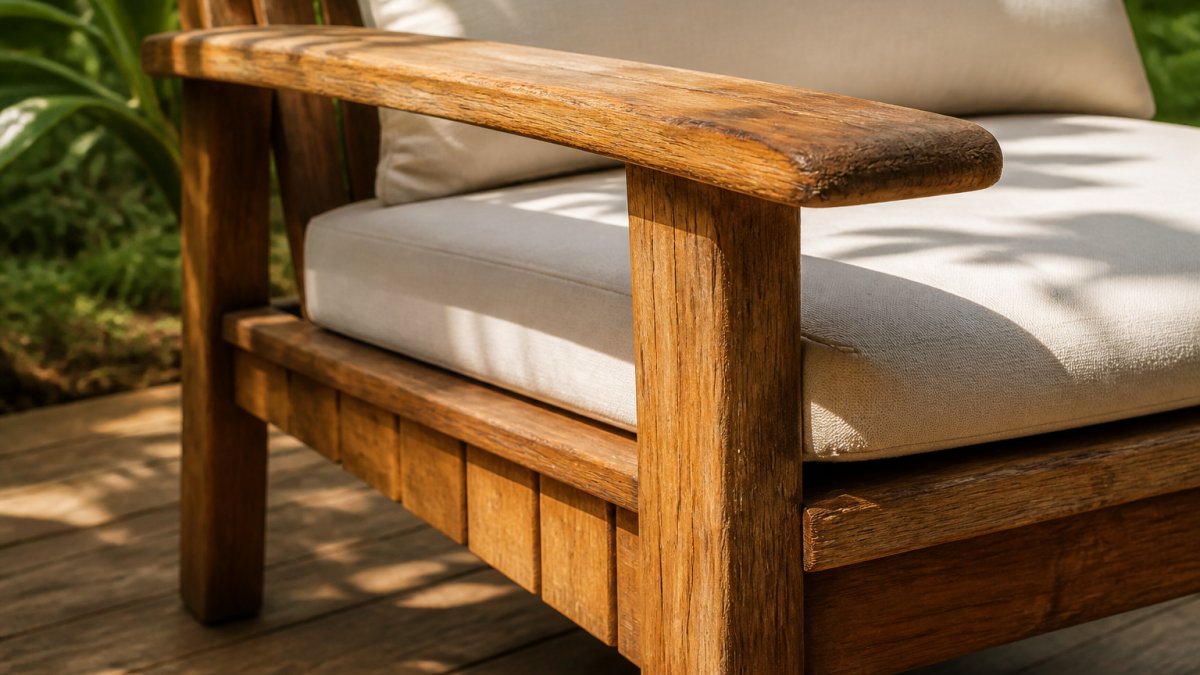
Acacia vs Teak Outdoor Furniture: Strength and Longevity
Acacia is often positioned as a budget-friendly teak alternative, and rightly so: it's a strong hardwood with respectable moisture resistance. But the comparison has limits.
Acacia lacks teak's natural oils, so untreated it's more vulnerable to rot: in humid climates it can deteriorate within 5-7 years, whereas maintained teak often lasts 15-20 years or longer.
The real difference is maintenance commitment: oil acacia annually and it delivers solid value; prefer minimal upkeep and teak's resilience justifies its price.
Hardwood Alternatives: Spotted Gum, Merbau, and Others
Beyond teak and acacia, several hardwoods offer distinct advantages depending on your priorities.
Spotted Gum is an Australian native hardwood denser than teak, naturally resistant to termites and rot, with striking reddish-brown grain.
Merbau is a Southeast Asian hardwood harder than teak with excellent durability and natural insect resistance, though less widely available locally and carrying sustainability concerns in some regions.
Jarrah and Karri are Western Australian natives, extremely hard and naturally durable outdoors.
In practice, hardwood choice depends on availability, maintenance tolerance, and budget.
Composite and Faux Teak Options
Composite materials, wood fibres bound with plastic resin, don't rot, don't need oiling, and resist weathering without maintenance. Colour fades, but structural integrity holds for 10-15 years or more.
The trade-off is aesthetic: composite feels plastic-like, lacks timber's warmth, and never develops the character natural wood gains with age. Acceptable in some spaces, a deal-breaker in others.
Faux teak, composite mimicking teak's appearance, bridges this gap with varying results. High-end versions come closer to real wood but cost approaches entry-level teak, eroding the budget advantage.
Teak Furniture Maintenance: What You Really Need to Know
Teak's reputation often outpaces reality: it requires less maintenance than most alternatives, but zero maintenance is a myth.
Untreated teak weathers to silver-grey within 12-18 months.
Without oiling, teak won't rot or fail structurally, it simply changes appearance. Some homeowners embrace the patina; others find it disappointing after paying premium prices.
Acacia and spotted gum need oiling every 6-12 months to hold colour and extend lifespan; composite needs occasional cleaning but no oiling.
The reality: teak is genuinely low-maintenance relative to other natural woods, but "low" doesn't mean "none."
Sustainable Outdoor Furniture Materials: Ethical Sourcing Matters
If environmental impact influences your choice, sourcing matters as much as the material. Here's what certifications verify, how to check them, and where the trade-offs sit.
What Certification Actually Means
FSC (Forest Stewardship Council) certification is the most widely recognised timber verification. It comes in three forms, and the difference matters when buying furniture:
- FSC 100%, every fibre in the product comes from FSC-certified forests.
- FSC Mix, the product combines certified, recycled, and/or controlled wood.
- FSC Recycled, the wood content is reclaimed or post-consumer material.
A piece labelled simply "FSC" without one of these qualifiers tells you less than it appears to. Ask which category applies, and for the certificate code (format: FSC-C######) so you can verify it on the FSC public database.
PEFC (Programme for the Endorsement of Forest Certification) is the other major international scheme, recognised in Australia through Responsible Wood, the local PEFC-endorsed standard. If a supplier can't tell you which scheme and category applies, treat the claim as unverified.
Why Teak Sourcing Is the Hardest Case
Teak is native to South and Southeast Asia, where demand has historically outpaced legal supply, conditions that breed illegal logging and mislabelling, often via timber shipped through a second country and documented as originating somewhere with weaker enforcement. Certification is the main defence, but only if you check the code rather than trust the label.
Plantation teak (grown on managed estates rather than in natural forest) is generally the lower-impact choice, though it still carries the shipping footprint of getting the timber to Australia.
Local Hardwoods and the Freight Question
Australian native hardwoods such as spotted gum, jarrah, and karri are often the lower-carbon option locally, mainly because they don't cross an ocean. But "local" isn't automatically sustainable, it depends on managed forest versus cleared native stand. Responsible Wood certification and state forestry regulations are the relevant checks.
Composites: The Honest Trade-Off
Composite is often marketed as eco-friendly because it outlasts cheap timber, partly true, since a piece surviving 12 years instead of 4 avoids several replacement cycles. But most composites use petroleum-derived resin, don't biodegrade, and are hard to recycle. Recycled-plastic composites reduce virgin plastic use but still carry embedded manufacturing carbon.
Realistically: composite wins on lifespan-per-unit-of-material, natural timber wins on end-of-life impact and repairability. Neither is unambiguously greener.
What to Ask Before You Buy
- Which certification scheme applies, and what is the certificate code?
- Is the timber plantation-grown, managed-forest, or of unknown origin?
- For local hardwoods, which state or region, and under what forestry regime?
- For composites, what proportion is recycled content, and can it be recycled again?
Performance and Durability: How Alternatives Stack Up
Below is a consistent rating across the criteria that determine whether you'll still be happy in year five, plus the total-cost picture most guides skip.
Side-by-Side Ratings
Ratings are relative, not absolute, "Good" for acacia means good for a hardwood in this class, not good compared to teak.
| Material | Rot Resistance | Insect Resistance | Colour Stability | Maintenance Burden | Expected Lifespan (outdoor, maintained) |
|---|---|---|---|---|---|
| Teak | Excellent | Excellent | Greys in 12-18 months if untreated | Low (annual oiling optional) | 15-25 years |
| Acacia | Good | Fair | Greys in 6-12 months | Moderate (oil every 6-12 months) | 8-12 years |
| Spotted Gum | Excellent | Excellent | Greys in ~12 months | Low-moderate (oil every 12-18 months) | 15-20 years |
| Merbau | Excellent | Excellent | Greys in 12-18 months | Low (annual oiling optional) | 15-20 years |
| Jarrah / Karri | Excellent | Excellent | Greys in 12-18 months | Low (annual oiling optional) | 20+ years |
| Composite | Excellent | N/A | Fades gradually, no greying | Very low (occasional cleaning) | 10-15 years |
What the Ratings Actually Mean in Practice
Rot resistance matters most on wet ground, near pools, or in humid coastal air.
Insect resistance is the quiet differentiator. Termites are a real risk in much of Australia; spotted gum, jarrah, and karri are naturally resistant, while untreated acacia in termite-prone areas is a genuine liability.
Colour stability is where expectations most often diverge from reality. Every natural timber here greys if untreated, UV exposure, not decay. The question is whether you accept the patina or commit to oiling.
Total Cost of Ownership
Upfront price alone is the least useful number. A more honest comparison is cost per year of serviceable life, including maintenance.
- Teak: highest upfront, lowest annual maintenance, longest life, annualised cost often beats cheaper alternatives that need replacing.
- Acacia: lowest upfront, most frequent maintenance, shortest life, annualised cost can exceed teak once oiling and earlier replacement are counted.
- Spotted gum / merbau: mid upfront, low maintenance, long life, frequently the best annualised value for natural timber without teak pricing.
- Composite: mid upfront, near-zero maintenance, moderate life, wins on convenience, loses on repairability, since a cracked panel usually can't be sanded or refinished.
Climate and Use-Case Guidance
- Humid coastal settings: prioritise rot and insect resistance, teak, spotted gum, merbau, jarrah, and karri perform well; acacia needs more attention; untreated composite is structurally fine but fades faster in strong UV.
- Drier inland settings: acacia performs adequately with annual oiling, and lower humidity reduces rot pressure; composite also holds up well.
- Poolside or exposed decks: teak, spotted gum, and merbau are the safest natural choices; avoid untreated acacia in constant splash zones.
- Sheltered courtyards and covered balconies: almost any option works, including acacia and composite, since UV and moisture exposure are reduced.
- Indoor or semi-indoor use: appearance and comfort matter more than weather resistance, teak and spotted gum offer the warmest natural finish; composite feels cooler and more synthetic.
The Maintenance Reality Check
Premium materials left unmaintained will underperform budget materials that receive regular care. A teak table ignored for a decade will still be structurally sound but fully greyed; an acacia table oiled twice a year may outlast a neglected teak piece in appearance terms. The material sets the ceiling, your maintenance habit determines where you land beneath it.
Zenteak's handcrafted pieces are built around this principle: choose materials that reward care and last long enough for that care to be worth giving.
Cost and Total Value: Making the Right Investment
Acacia costs roughly 30-50% of teak, spotted gum sits between them, and composite typically costs 20-40% less than entry-level teak but more than acacia.
But total cost of ownership tells a different story.
Consider your timeline: furnishing a space for decades justifies teak or spotted gum; a rental or temporary setup suits acacia or composite.
Zenteak's handcrafted pieces prioritise longevity and sustainable sourcing, designed to become part of your home's story and improve with age and use.
Choosing the Right Alternative for Your Space
Your choice depends on four variables: budget, maintenance tolerance, aesthetic preference, and environmental values.
Choose acacia if: you want natural wood aesthetics at a lower price and will oil annually.
Climate matters too. In humid coastal regions, rot resistance becomes critical, teak, spotted gum, or merbau outperform acacia.
The strongest choice combines material durability with honest assessment of how much maintenance you'll actually perform.
Zenteak's collection emphasises handcrafted quality and sustainable sourcing across teak and complementary materials.
Frequently Asked Questions
What is the best substitute for teak wood in outdoor furniture?
Acacia hardwood offers excellent durability and weather resistance comparable to teak, with similar grain appearance and a lower price point. For low-maintenance alternatives, composite materials mimicking teak's aesthetic eliminate the need for regular oiling. Spotted gum and merbau are premium native hardwoods that rival teak's longevity. The best choice depends on your climate, budget, and willingness to perform maintenance, each alternative excels in different contexts.
How does acacia compare to teak for outdoor furniture durability?
Acacia is a hardwood with Janka hardness ratings comparable to teak, offering strong weather and moisture resistance. Both species resist rot and insect damage, making them suitable for outdoor use. Teak contains natural oils providing superior longevity in extreme conditions, while acacia requires more regular maintenance but costs significantly less. For most temperate outdoor settings, acacia performs reliably over 10-15 years with proper care.
Which wood needs the least maintenance for outdoor furniture?
Composite materials engineered to replicate teak require virtually no maintenance, no oiling, staining, or sanding. Among natural hardwoods, teak requires minimal upkeep due to its natural oil content, though occasional cleaning extends its life. Acacia and spotted gum demand more regular maintenance, including annual oiling to prevent greying and weathering. If low maintenance is your priority, composite alternatives or sustainably sourced teak offer the best balance of durability and convenience.
What should you consider when choosing a teak alternative?
Evaluate climate exposure, desired aesthetic, maintenance commitment, budget, and sustainability values. Consider whether you need marine-grade durability for poolside settings or standard weather resistance for covered patios. Assess the wood's hardness rating and natural oil content. Check certifications for responsible sourcing, FSC certification indicates ethical forestry. Factor in long-term costs: cheaper alternatives may require more frequent replacement or maintenance, affecting total cost of ownership over 10-20 years.